A zipper bag making machine converts polymer film into reclosable packaging: it continuously feeds the web, integrates the interlocking profile, seals the pouch perimeter, and cuts individual units to length.
Before comparing machinery quotations, three operational variables dictate your actual equipment requirements—and none of them originate at the sealing knife: how the zipper profile is introduced to the web, the finished pouch geometry, and the exact seal failure mode your line must prevent. Our BJAT+S servo edge side-sealing bag making machine is rated at 200 pcs/min across all three frame sizes, and it takes either pre-extruded zippered film or in-line profile attachment.
If you already have a target pouch format, send us a physical sample. Evaluating the actual pouch and its resin structure resolves in a single step what theoretical specification sheets take weeks of back-and-forth to clarify.
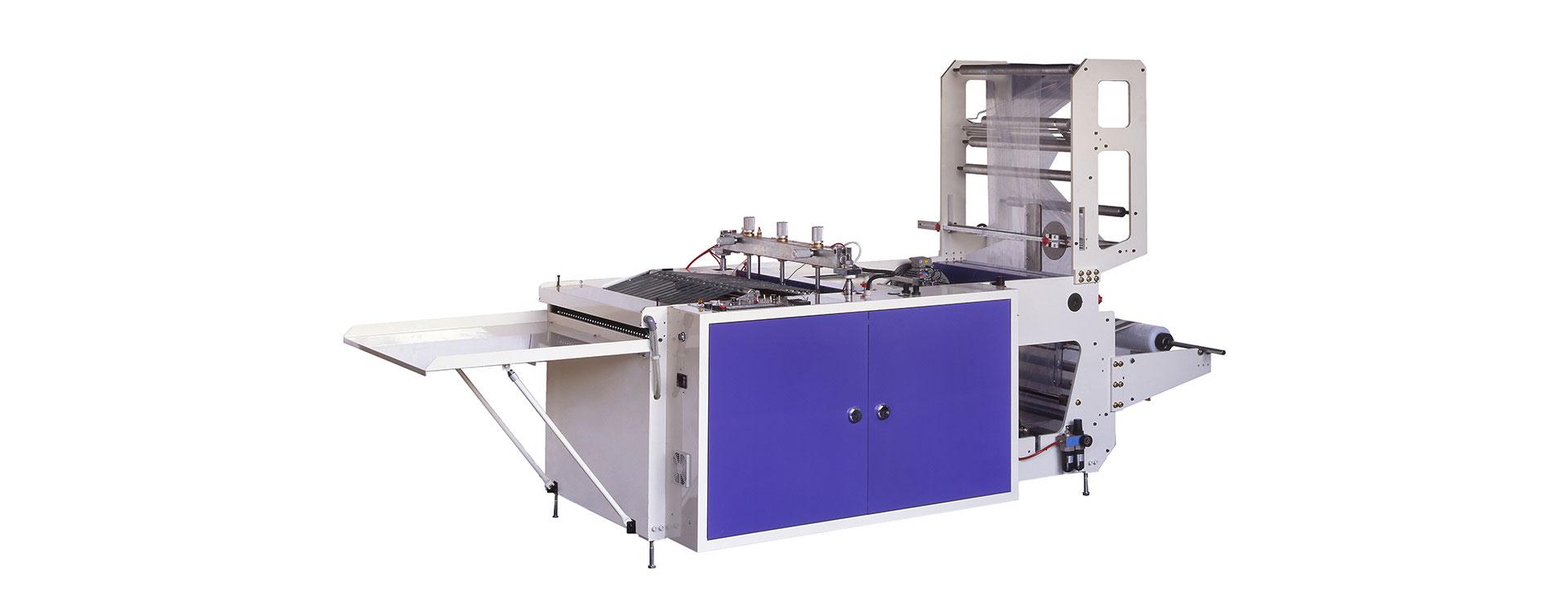
The BJAT+S servo edge side-sealing bag making machine.
An industrial zipper bag making machine is an automated converting line that transforms tubular or folded plastic film into reclosable packaging. It unwinds the substrate, positions or bonds the interlocking zipper profile, executes lateral thermal side-sealing, cuts the bag to length, and stacks finished units. The primary engineering differentiators lie in the zipper delivery route (blown integral film vs. in-line attachment) and how cross-sealing thickness differentials are handled to prevent structural defects.
Unlike conventional bag converting machinery designed for uniform film webs, a zipper bag making machine must manage a substantial material thickness differential during every cycle. The BJAT+S runs film from 15 to 80 microns, and the extruded male and female zipper tracks are rigid and substantially thicker than the web on either side of them.
To maintain hermetic seal integrity without pinholes or distortion at speeds up to 200 pcs/min, the machine coordinates high-response servo feeding, precision profile guiding fixtures, and rigid lateral heat-sealing bars. Depending on factory workflow, the system converts pre-zippered master rolls or in-line feeds and bonds standalone zipper tape onto flat film before cutting and stacking finished pouches.
Trade catalogues list this equipment under at least six different names. Sorting those names out is where selection actually starts.
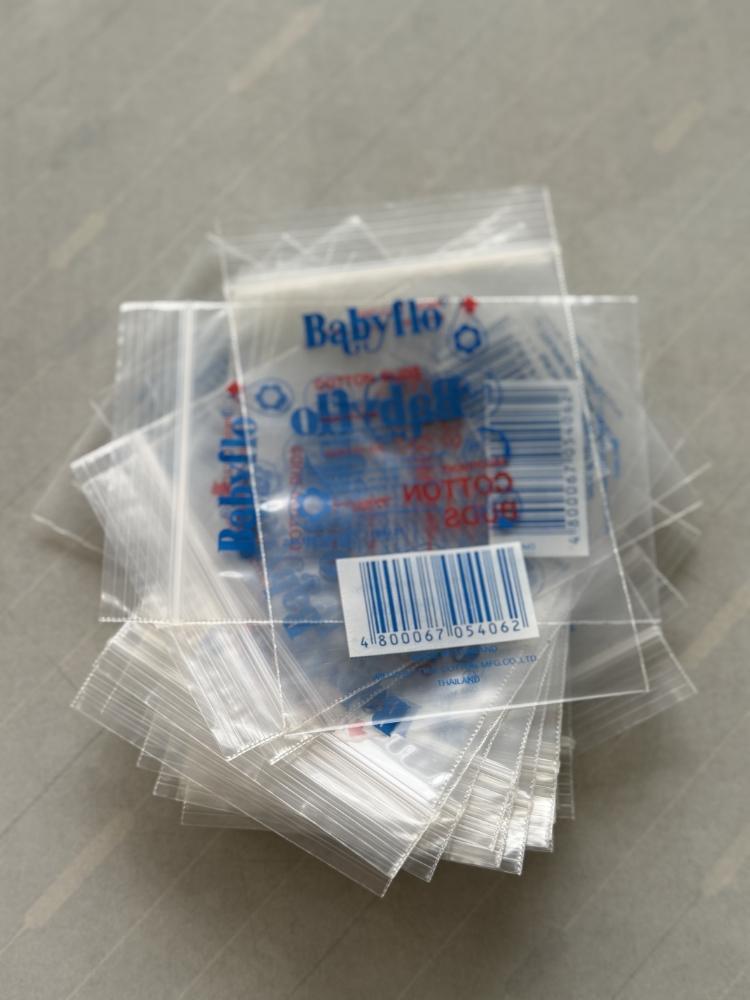
Flat press-to-close zipper bags: the closure runs across the top opening.
When researching machinery in this category, buyers constantly encounter six common equipment classifications:
Read as a single flat list, they look like six mutually exclusive alternatives, causing procurement teams to stall. In reality, they are not competing answers to the same question—they answer three completely separate operational decisions:
| The Operational Question | The 6 Industry Terms | What It Decides on Your Shop Floor |
| Question 1: How does the zipper reach the bag? | 1. Blown Integral Zipper Film 2. In-Line Zipper Attachment | What raw materials you purchase, inventory requirements, and material lead times |
| Question 2: What physical geometry must the bag hold? | 3. Flat Press-to-Close Bag 4. Slider Zipper Bag 5. Stand-Up Doypack | The chassis mechanics, required forming stations, and machine footprint |
| Question 3: How many production lanes run simultaneously? | 6. Twin-Line / Deli Bag (vs. Single-Lane) | Hourly output volume versus film gauge uniformity requirements |
Sorting the choices this way clarifies your factory roadmap:
Once you have settled on an edge side-sealing machine, the next question is sealing yield. At 200 pcs/min, which seal defects actually occur, and where does ultrasonic sealing belong?
Nearly every specification sheet in this category promotes ultrasonic sealing as an optional upgrade. Yet very few clarify exactly which defect the module is engineered to prevent. That distinction is critical on the factory floor: reclosable pouches do not suffer from a single defect type. They encounter two distinct sealing issues occurring in completely different locations under different stress mechanics, and no single mechanism resolves both.
| Defect Type | How the end user reports it | Where it physically happens on the pouch |
| Interlock grip failure | The bag will not stay shut, or opens by itself under load | At the interlock, along the entire length of the zipper profile |
| End notch splitting | The bag tears at the side seam crossing during opening or transport | At the two lateral points where the side seal crosses the zipper track |
Grip failure shows up at the interlock itself, where the two halves of the zipper meet, rather than at the thermal seal line. The bag closes, but it does not hold.
Two variables govern this behavior: the quality and tolerances of the zipper profile you run, and the alignment setup on the converting machine. In factory practice, alignment calibration is handled as an independent setup process, while profile consistency determines how securely the teeth engage under internal pressure. Field experience shows both require independent attention.
A bag that fails this way comes back from the end user after packaging, not from your production line, which is why it is costly to discover late.
End splitting happens at two specific points: where the vertical side-seal knife cuts across the zipper profile. The heated seal knife must cross something substantially thicker and stiffer than the film on either side of it. Every time the bag is pulled open, stress concentrates directly at those two crossings.
This is the specific defect ultrasonic spot reinforcement is engineered to resolve. The ultrasonic welds go precisely where the load concentrates, at the two lateral ends, rather than running heat along the entire seam.
Worth saying plainly: the complaint that reaches us most often is the interlock popping open, not the end corners tearing. We would rather set that out than let ultrasonic spot welding be read as an answer to every closure problem. If your pouches engage but will not stay shut under load, your capital is far better invested in tighter zipper extrusion tolerances and precise web-guiding alignment than in an auxiliary sealing module.
Ultrasonic sealing appears on zipper bag machines in two forms, and quotations rarely distinguish them:
We can configure either, so the question to settle first is which fault you are stopping. A bag that splits at the zipper ends needs spot welds at those two crossings. A bag that weeps along the side seam needs a continuous ultrasonic seam.
Once the sealing configuration is settled, what is left is drive, feed precision and sustained cycle rate. Here is how those read on our BJAT+S.
Five core engineering metrics determine true production efficiency on side-sealing lines. Rather than relying on marketing descriptors, evaluate each factor against published figures, using our BJAT+S servo bag making machine as the benchmark:
| Equipment Section | Compatible Substrate Range |
| BJAT+S Base Converting Machine | High-density polyethylene (HDPE), low-density polyethylene (LDPE), polylactic acid (PLA), biodegradable films, recycled films (15 to 80 microns) |
| Ultrasonic Spot Sealing Module | Polyethylene (PE), polypropylene (PP), laminated multi-layer barrier films |
The cutting widths in the model designation represent nominal frame sizes. For instance, the BJAT+S 20" provides a maximum effective cutting width of 457 mm (18 inches). Always compare your required bag size against the mechanical specification matrix below:
| Specification Parameter | BJAT+S 20" | BJAT+S 28" | BJAT+S 32" |
| Max. cutting width mm (inch) | 457 (18") | 660 (26") | 762 (30") |
| Max. cutting length mm (inch) | 76–762 (3"–30") | 76–762 (3"–30") | 76–762 (3"–30") |
| Thickness micron/sheet | 15–80 | 15–80 | 15–80 |
| Length tolerance mm | ±1 | ±1 | ±1 |
| Production rate pcs/min | 200 | 200 | 200 |
| AC driving motor HP | 2 | 2 | 2 |
| Heater capacity kW | 1.5 | 2.2 | 2.8 |
| Power required kW | 7.5 | 8.2 | 8.8 |
| Machine dimensions L x W x H cm | 300 x 135 x 190 | 300 x 155 x 190 | 300 x 165 x 190 |
| Machine weight kg | 1,300 | 1,600 | 2,000 |
A practical caution on bag length: The 76 mm minimum length reflects flat pouch converting. When introducing a zipper track across the top opening, the minimum workable pouch length may increase slightly depending on tooling clearances. Always specify your shortest target pouch length during technical consultation. All figures above reflect the base machine running at 200 pcs/min.
Film compatibility, retrofits and changeovers are what come up next. Here are the five questions we are asked most.
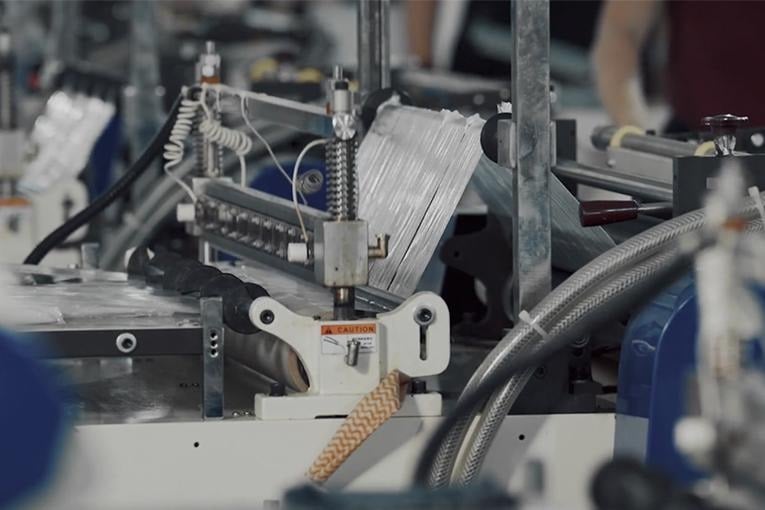
Seal bar and pin-stacking on a running line.
Provide a physical sample of your target pouch along with its film structure. If the package is still under development, supply a commercial market sample of similar geometry together with resin specifications from your film extruder. A 2D drawing alone provides dimensions but reveals nothing about closure stiffness or film melt behavior, which directly determine machine mechanics.
Flat press-to-close pouches sealed along both lateral side edges: retail zipper packaging, reclosable food bags, apparel bags, and reinforced pouches. The zipper can be integral on the film or fed on the machine. Light retail bags opened only once or twice rarely justify ultrasonic spot welding, and we will advise you accordingly rather than quoting it by default.
Either approach is supported. Clear polyethylene bags typically run efficiently on pre-zippered film rolls. Multi-layer foil or paper barrier laminates require standalone zipper tape fed on the machine because laminates cannot carry an in-die extruded profile. Tell us during quotation if your plant plans to run both.
No. Spot welds reinforce the two lateral ends of the zipper against notch tearing. A zipper that closes but pops open is an interlocking profile tolerance or mechanical alignment issue, which is resolved through raw material quality control and web guiding adjustment.
Not on the BJAT+S. All three cutting widths (20", 28", and 32") maintain 200 pcs/min under servo control with ±1 mm length tolerance. When evaluating competitor quotes, always verify what bag width their quoted speeds were achieved at.
At this point a sample tells us more than another round of specifications.
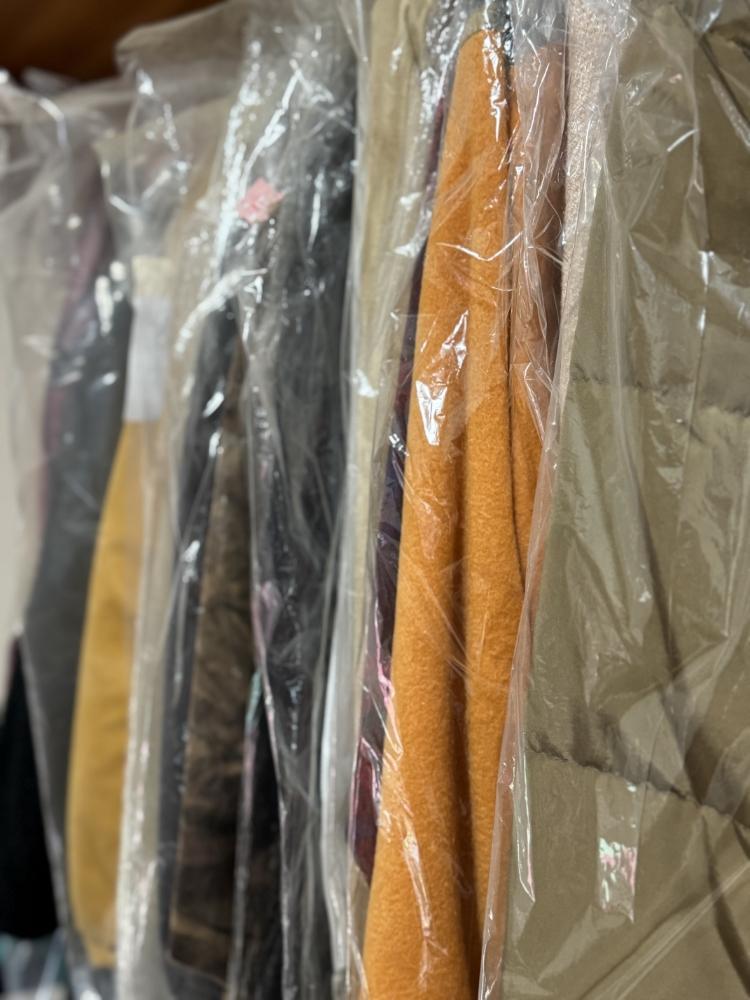
Apparel and dust bags, one of the formats this machine suits.
Most initial inquiries state only "we need a zipper bag machine." The fastest, most dependable way to bypass ambiguity is a physical sample. Evaluating the physical sample and its substrate allows our engineering team to define the exact mechanical configuration required. Where technical specification discussions can take weeks of back-and-forth, a physical sample settles the machinery specification in a single review.
If a physical sample is not yet available, begin with the substrate: specify whether you run clear polyethylene or laminated barrier web, film thickness, and target package weight.
Please send us an inquiry via the contact form.


