A plastic shopping bag making machine converts blown polymer film into durable retail carrier bags: it continuously feeds tubular or folded film webs, executes transverse heat-sealing, forms integrated carry handles through mechanical die-cutting or reinforcement attachments, and stacks finished units for packing.
Almost every difference between these machines comes down to how the handle is made. A T-shirt bag uses a U-cut, a die-cut bag a punched hole, a patch handle bag a welded reinforcement, a soft loop bag a welded strip — four handles, four different forming mechanisms. Settle that first, and most of the other specifications follow from it.
Machinery procurement does not start with catalogue cycle speeds. It starts with a physical bag sample, the resin you run, and a clear picture of the automation you want downstream. Below we cover the common shopping bag formats and the machines that match them, what wears and how to maintain it, line configurations, and eco-resin processing.
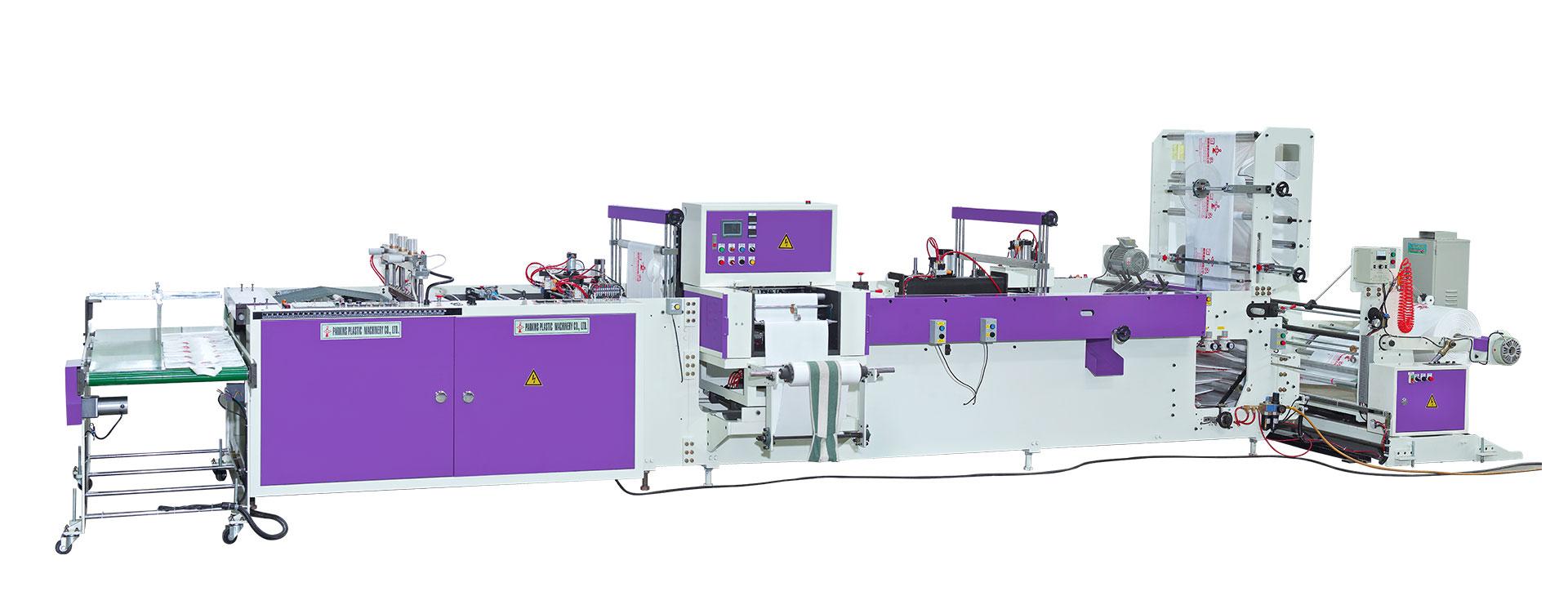
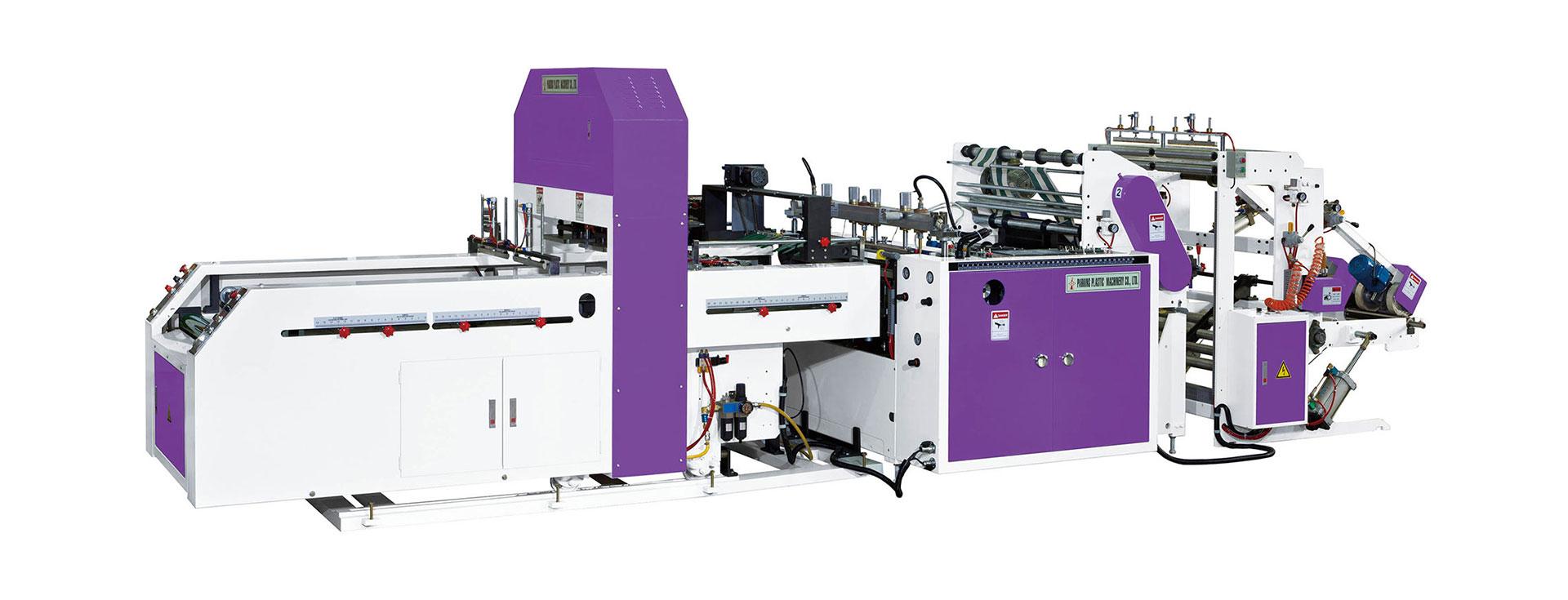
The BJAT+PLD side-seal handle bag line. The patch reel and vacuum transfer station sit mid-line.
Unlike flat liner or trash bag machinery that only requires straight transverse thermal sealing and guillotine cutting, plastic shopping bag making machines integrate specialized mechanical tooling to form carry handles capable of supporting dynamic retail loads. The continuous converting sequence consists of five synchronized mechanical operations:
Whether one chassis covers several formats depends on whether the handle-forming station can be swapped with optional tooling. On our BJAT+PLD multi-functional side-seal series, patch handle, soft loop handle, die-cut punch handle and drawstring bags run on the same machine through optional modules. Sealing orientation (bottom-seal versus side-seal) and downstream automation are built into the chassis, so tooling changes will not alter them. Separating those three questions narrows a shortlist quickly.
The machine configurations shown below are common starting points for selection, not universal rules. Final compatibility depends on bag geometry, film structure, sealing orientation, handle construction, and the machine's available options:
| Shopping Bag Style | Target Retail Application | Common Machine Configuration | Primary Film Resins | Handle Load-Bearing Mechanism |
| T-Shirt Bag (Vest Carrier Bag) | Supermarkets, grocery chains, convenience stores, retail take-out | High-Speed Continuous Bottom-Seal Machine with In-line or Offline Hydraulic U-Cut Punch (e.g., our BJABP-AS Series) | HDPE, Recycled PCR blends, Certified Compostable PLA/PBAT | Direct Punched: Load is borne primarily by the parent film web around the handle cutout |
| Die-Cut Handle Bag (Punched-Out Handle) | Apparel boutiques, pharmacies, general dry goods merchandise | Bottom-Seal or Side-Seal Bag Machine with Integrated Oval/Kidney Die-Cut Station | LDPE, LLDPE, HDPE, Recycled PCR | Direct Punched: Load concentrates along the upper film border; carrying capacity is tied to base gauge |
| Patch Handle Bag (Reinforced Handle) | Fashion retail, shoe stores, luxury department store apparel | Servo Side-Seal Machine with Automated Vacuum Patch Feeder & Thermal Welder (e.g., our BJAT+PLD Series) | LDPE, LLDPE, Multi-layer co-ex films (body film + reinforcing patch) | Thermal Bond Boundary: Load is distributed across the welded reinforcement patch and thermal perimeter |
| Soft Loop Handle Bag (Flexible Loop Tote) | Department store gift shops, branded retail, heavy volume shopping | Servo Side-Seal Machine equipped with In-line Soft Loop Extruded Strip Welder (e.g., our BJAT+PLD Series) | LDPE, LLDPE, Soft tactile blends (body film + flexible PE handle strips) | Welded Anchor Points: Load transfers directly to the independent thermal weld points on the bag lip |
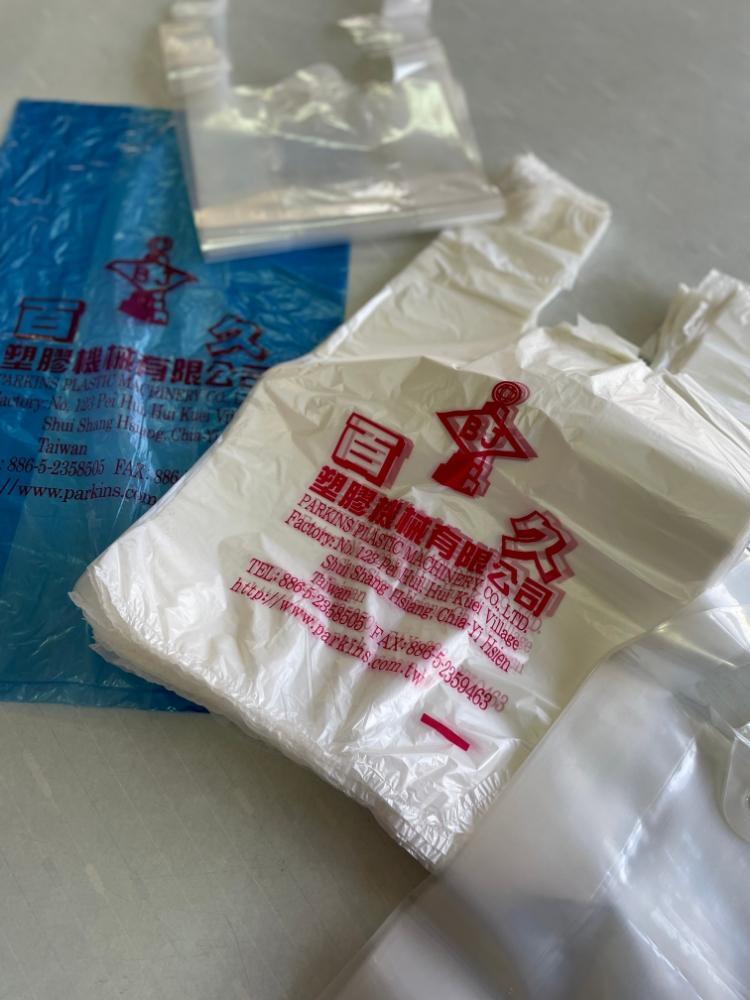
T-shirt bag: the U-cut handle is punched straight through the film.

Soft loop handle bag: the handle is welded on as a separate strap.
Understanding how handle design influences film consumption represents a crucial cost consideration for bag converters:
In commercial shopping bag converting, line reliability depends primarily on key servo-mechanical and pneumatic sub-assemblies. Here is where our service engineers look first on T-shirt and patch handle lines:
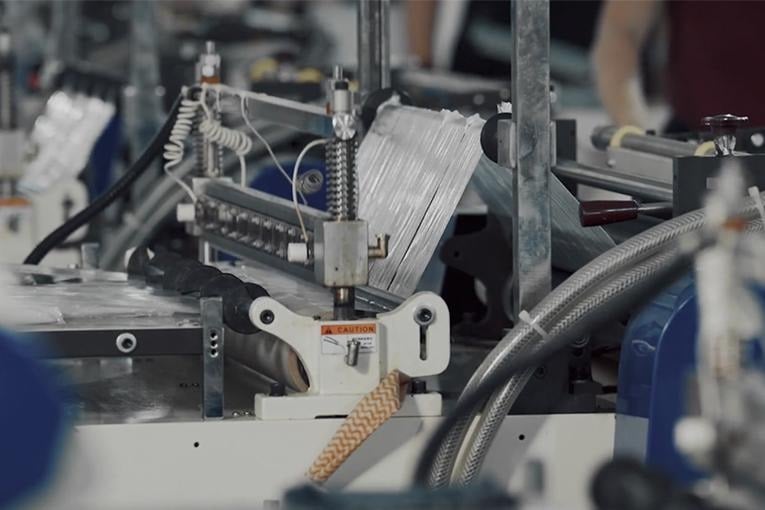
Seal bar and pin-stacking on a running line.
On continuous T-shirt bag machines, the servo motor and drive system govern intermittent film advance between seal strokes. When the servo system experiences tracking drift, electrical noise, or mechanical belt slack, converters encounter three immediate issues:
On side-seal patch handle bag machines (such as the BJAT+PLD), reinforcement patches are cut from an auxiliary reel, gripped via vacuum suction cups on a transfer arm, and welded onto the indexed web. Common troubleshooting areas include:
These are the maintenance questions our technical support team receives most often.
Tooling life varies with film composition, mineral additives, cutting geometry, shift hours, and maintenance practices. Rather than relying on a static calendar interval, converters should establish inspection and re-grinding schedules based on production records and observed cut quality. On standard PE films, quality alloy tool-steel blades provide extended service before re-sharpening. However, processing films with high calcium carbonate (CaCO3) fillers or abrasive post-consumer recycled (PCR) resins accelerates cutting edge wear, warranting hardened tool-steel or carbide-tipped tooling and more frequent edge inspections.
Catalog speed indicates the mechanical cycle capability of the machine chassis under dry conditions. In actual production, optimal continuous working speed is governed by film cooling kinetics, thickness, and heat-sealing dwell time. Running thin virgin HDPE allows higher cycling rates, whereas heavier gauges, multi-layer gussets, or compostable materials require longer thermal contact and cooling dwell, necessitating adjusted line speeds to ensure zero-defect production.
When evaluating shopping bag manufacturing economics, converting output depends on machine configuration, lane allocation, handle punching methods, and downstream collection ergonomics.
Multi-lane configurations can increase overall output, but actual bag production per minute depends on the number of lanes, mechanical cycle speed, bag length, indexing stability, and operating conditions:
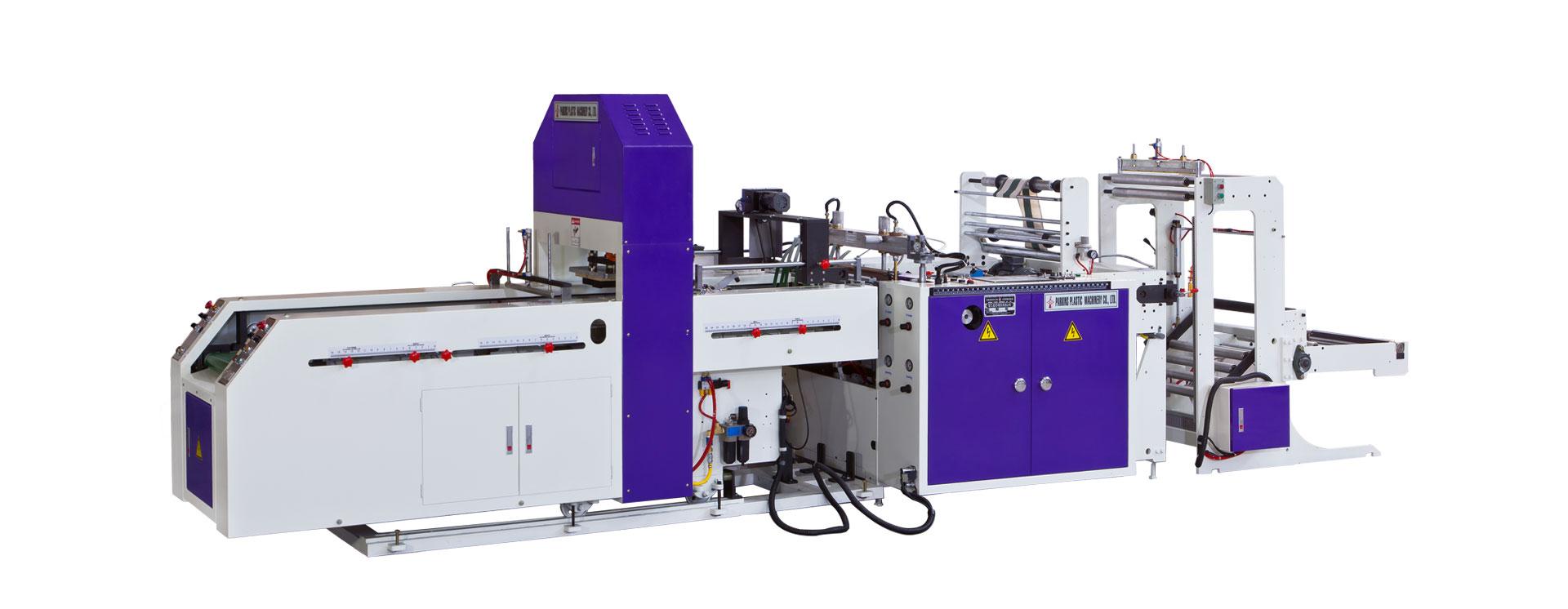
BJABP-AS1, single lane.
BJABP-AS2, two lanes.
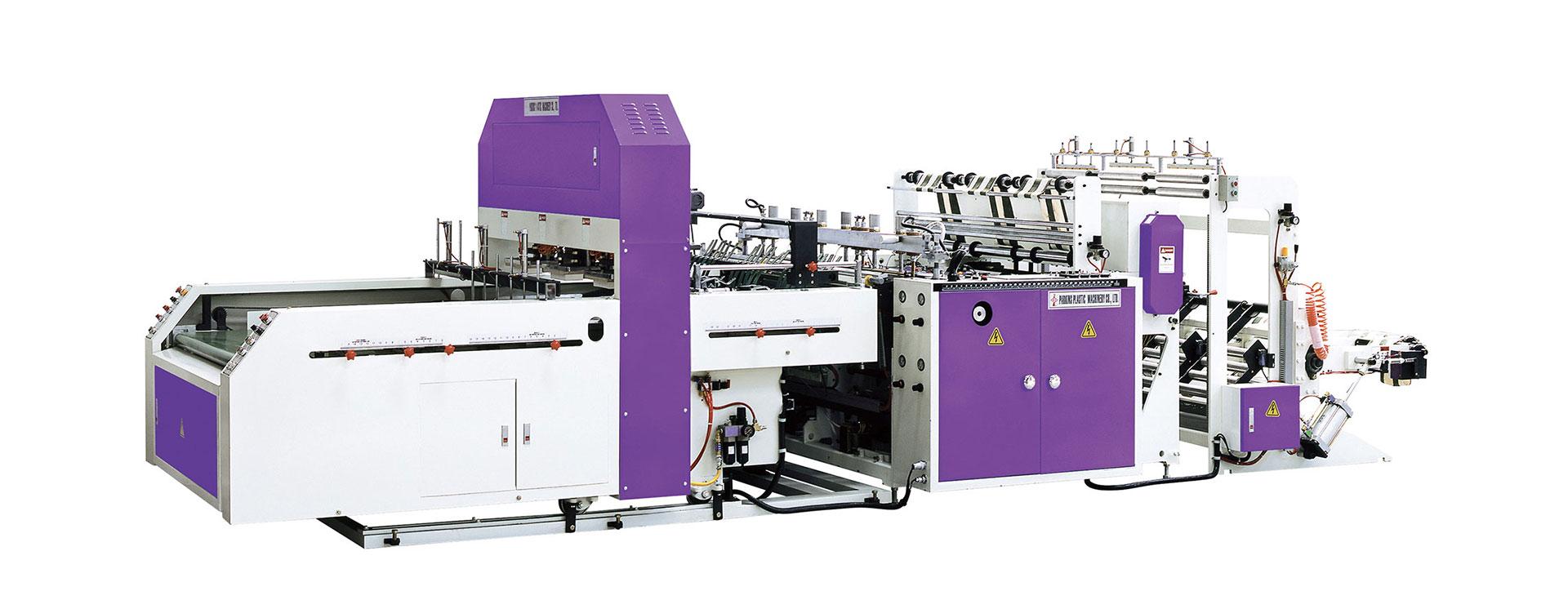
BJABP-AS3, three lanes.
The operational choice for cutting out T-shirt handles influences labor allocation and workflow:

A standalone hydraulic punch press, the offline route for U-cut handles.
One detail that comes up in nearly every consultation we run is downstream collection planning. At commercial cycling speeds, finished bags require structured handling: thermal pin-stacking (pin-blocking) to keep bag packs aligned, variable-speed conveyor tables for shingled manual carton packing, or automated pack transfer tables. Evaluating these collection methods during machine quotation prevents unexpected labor bottlenecks on the plant floor.
Single-use plastic regulations worldwide are accelerating the transition from virgin polyethylene to certified compostable polymers (PLA, PBAT, starch blends) and Post-Consumer Recycled (PCR) resins. We offer selected machine configurations equipped to process these substrates.
Biodegradable and recycled polymers differ substantially in composition, heat-sealing behavior, stiffness, and melt strength compared to prime HDPE/LDPE. The table below outlines potential machine adjustments for running eco-resins:
| Eco-Resin Category | Common Converting Considerations | Potential Machine Adjustments or Options | Operational Observations |
| Biodegradable / Compostable (PBAT, PLA, Bio-blends) | • Narrow thermal sealing window • Sensitive to thermal degradation & sticking • Lower melt strength under web tension • Formulations vary widely by resin supplier | • Digital PID temperature controllers for precise thermal stability • Non-stick PTFE (Teflon) coated sealing bars • Low-inertia dancer rolls and smooth servo acceleration ramps • Auxiliary air cooling immediately following thermal contact | Operating temperatures, dwell times, and line speeds should be established through trials with the specific film grade to ensure reliable seal integrity without stretching. |
| Post-Consumer Recycled (PCR Resins: 30%–100%) | • Batch-to-batch melt flow variation • Film gauge thickness tolerances across web • Potential micro-gels or particulate inclusions • Mineral additives (e.g., CaCO3) that accelerate tooling wear | • Resilient silicone rubber backup pads to absorb localized gauge variations • Multi-zone temperature regulation across wide sealing bars • Hardened alloy tool-steel or carbide-tipped punch dies • Anti-static ionizing bars to minimize electrostatic film clinging | Continuous running speed is typically governed by film gauge consistency and thermal uniformity; sample trials verify reliable sealing without pinholes. |
Engineering Note on Material Trials: Because compostable resin compounds and PCR blends exhibit diverse thermal and mechanical properties, we recommend trial runs on your own film rollstock before production parameters are fixed.
Most buyers who reach us arrive with a bag in hand, and that is the fastest route to a specification. If you have a sample, send it. If you do not yet, these four parameters are enough for us to narrow the machine range:
What we recommend: send a physical bag sample and film rollstock. Evaluating target pouch geometry, seal integrity, and polymer elasticity on our testing floor resolves in hours what theoretical datasheets take weeks of emails to debate. Contact us today to schedule an engineering consultation and configure a dependable, high-output shopping bag production line tailored to your market.


